

Visual Reasoning and Hidden Barriers in Math
Math, memory, and misinterpretation part 4
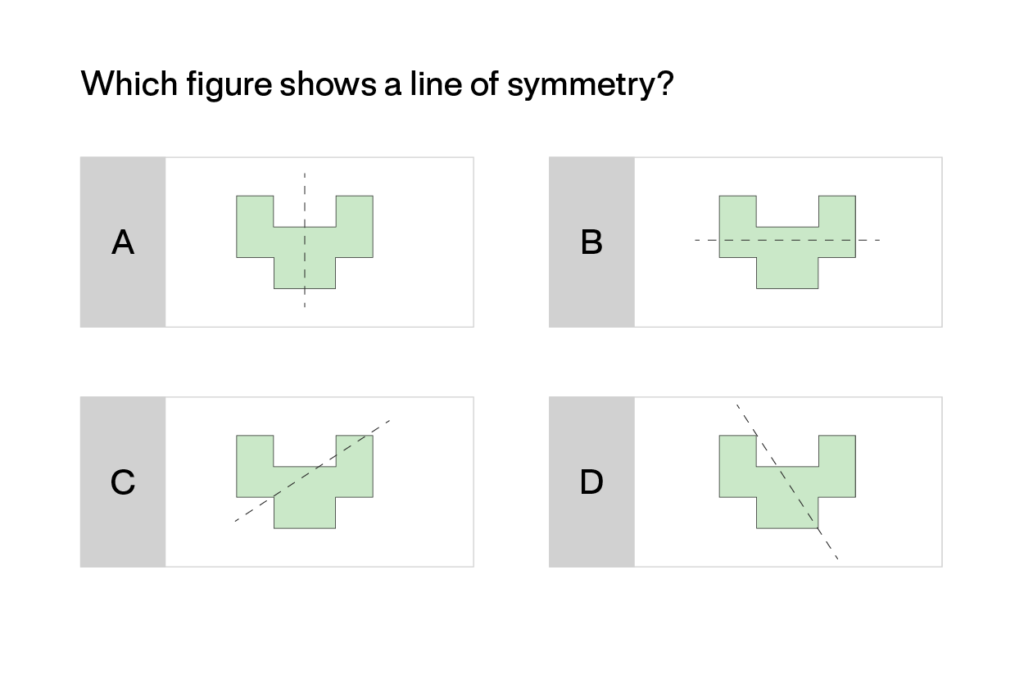
At first glance, this question seems visual and intuitive: identify which figure shows a line of symmetry. But for a student with dyscalculia, this task is not just about recognizing symmetry—it requires mental folding, spatial comparison, and visual filtering, all at once.
In this series, we continue exploring how standardized math questions can measure access barriers rather than true understanding—and how we can redesign them to preserve rigor while improving access.
Important note: Dyscalculia presents differently across individuals. The experience described below reflects one possible way a student may perceive this task, not a universal experience.
The original question
Source: https://www.nationsreportcard.gov/mathematics/sample-questions/?grade=4
Which figure shows a line of symmetry?
What the question intends to measure
This question is designed to assess:
- Understanding of line of symmetry
- Ability to recognize mirror images
- Spatial reasoning and shape transformation
- Conceptual understanding of geometric properties
This is a key foundational skill in geometry.
How this question may feel to a student with dyscalculia
The difficulty here is not just the concept—it’s the processing required to access the concept.
Visual complexity and comparison
The student must:
- Look at four similar shapes
- Compare each one against a proposed line
- Determine whether both sides match
This requires holding and comparing multiple visual representations simultaneously, which can be overwhelming.
Mental folding (abstract transformation)
To determine symmetry, the student must mentally:
- “Fold” the shape along the dotted line
- Predict whether both sides align
For many students with dyscalculia, this kind of mental transformation is not intuitive—it requires effortful reasoning.
Line orientation confusion
Each option includes a different line:
- Vertical
- Horizontal
- Diagonal (two directions)
The student must:
- Interpret the direction of the line
- Re-orient the shape mentally
This adds another layer of spatial demand.
Subtle differences between options
The shapes are similar but not identical in how they relate to the line.
For a student with dyscalculia:
- Differences may feel too subtle to confidently identify
- Multiple answers may appear “almost right”
- Guessing becomes more likely
Working memory load
To solve this, the student must:
- Examine a shape
- Imagine the fold
- Compare both sides
- Repeat for four options
This repeated processing can quickly overload working memory.
The question we should be asking
Is this question measuring:
- Understanding of symmetry?
Or:
- Visual discrimination
- Spatial transformation
- Working memory capacity
- Confidence in interpreting visual information
For students with dyscalculia, these are inseparable.
A dyscalculia-accessible rewrite of the question
Version 1: Structured for assessment (explicit)
A line of symmetry divides a shape into two matching halves.
Look at each figure.
- Imagine folding the shape along the dotted line. Do both sides match exactly?
Which figure shows a line of symmetry?
Why this helps:
- Makes the thinking process explicit
- Reduces ambiguity
- Supports conceptual reasoning
Version 2: Structured for visual support
This shape has a line of symmetry:
(Show one correct example with a clear fold)
Now look at the choices.
Which one works the same way?
This anchors the concept before asking for application.
Accommodations that preserve rigor
Instructional accommodations can…
- use physical folding activities (paper shapes)
- provide mirrors to demonstrate symmetry
- connect symmetry to real-world examples (faces, objects)
- explicitly teach how to test symmetry step-by-step
- reduce reliance on mental transformation by using hands-on models
Assessment accommodations can…
- allow students to trace or fold printed shapes
- provide faint gridlines to support visual comparison
- reduce the number of answer choices
- allow verbal reasoning explanations
- give extended time for visual processing
Language accommodations can…
- define symmetry clearly:
“A line of symmetry makes two matching halves.” - avoid abstract phrasing without examples
- use consistent wording across instruction and assessment
- break directions into steps rather than a single sentence
Understanding “wrong” answers as meaningful data
Choice A (Correct – vertical symmetry)
Shows:
- Accurate recognition of mirrored halves
- Successful mental or visual comparison
Choice B (Horizontal line)
Possible thinking: “The line goes through the middle, so it must be symmetry.”
Reveals:
- Surface-level reasoning
- Lack of true mirror understanding
Choice C (Diagonal line)
Possible thinking: “It looks balanced across the line.”
Reveals:
- Difficulty with spatial transformation
- Misinterpretation of symmetry
Choice D (Opposite diagonal)
Possible thinking: “All options look similar; this one seems just as valid.”
Reveals:
- Visual overload
- Reduced confidence leading to guessing
What this question actually diagnoses
Choice | Reveals difficulty with |
A | Strong symmetry understanding |
B | Concept vs. appearance confusion |
C | Spatial transformation |
D | Visual discrimination and confidence |
Classroom takeaways for educators
- Symmetry is not just visual—it’s transformational.
Students must mentally manipulate shapes.
- “Looks right” is not the same as understanding.
Students may rely on position or intuition instead of concept.
- Visual tasks can be cognitively heavy.
Especially when multiple comparisons are required.
- Hands-on experiences matter.
Folding and mirrors build understanding that visuals alone may not.
- Errors reveal thinking patterns.
Each wrong answer tells you how the student is reasoning.
Alignment with UDL and MTSS
UDL
- Representation: Visual + physical models of symmetry
- Action & Expression: Allow folding, tracing, or mirroring
- Engagement: Reduce frustration by making thinking visible
MTSS
- Tier 1: Explicit instruction with clear examples
- Tier 2: Guided practice with physical supports
- Tier 3: Hands-on interventions and repeated modeling
This is not just a question about symmetry. It’s a question about:
- how students visualize
- how they transform information
- and how confident they feel trusting what they see
When we reduce hidden barriers, we don’t simplify the math. We make understanding possible.