

How math feels with dyscalculia
Math, memory, and misinterpretation part I
For someone with dyscalculia, standardized, timed tests don’t feel like they are testing intelligence, but instead precision under pressure, visual filtering, or short-term memory, rather than the actual understanding of math concepts. This can lead to slower work speed, second-guessing, fatigue, frustration, and mistakes that look like carelessness from the outside.
In this series we’ll look at a few math questions from a fourth-grade standardized test and look at ways we can understand how a student with dyscalculia may see, perceive, and answer these questions before investigating how we can apply accommodations for those with dyscalculia.
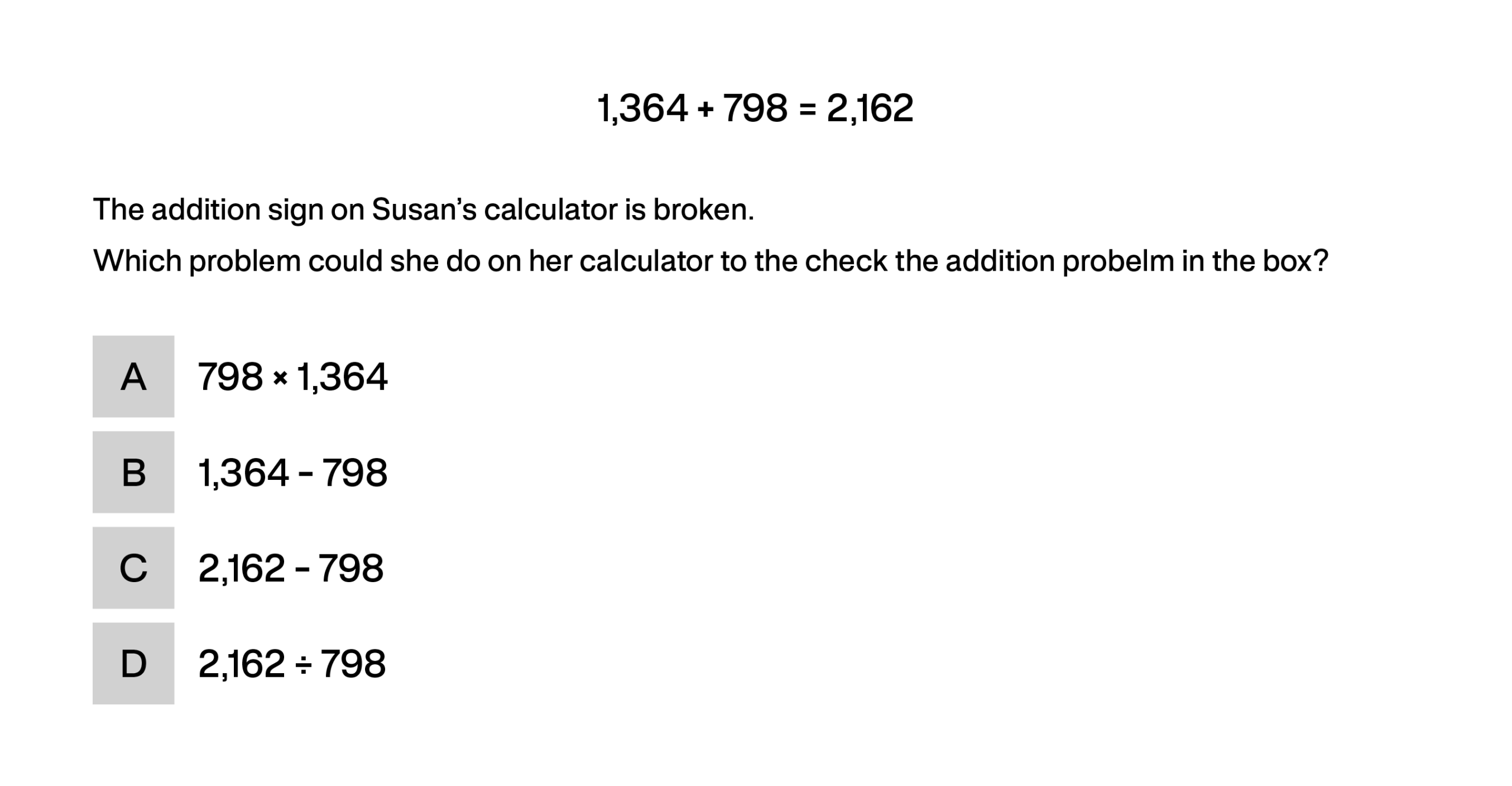
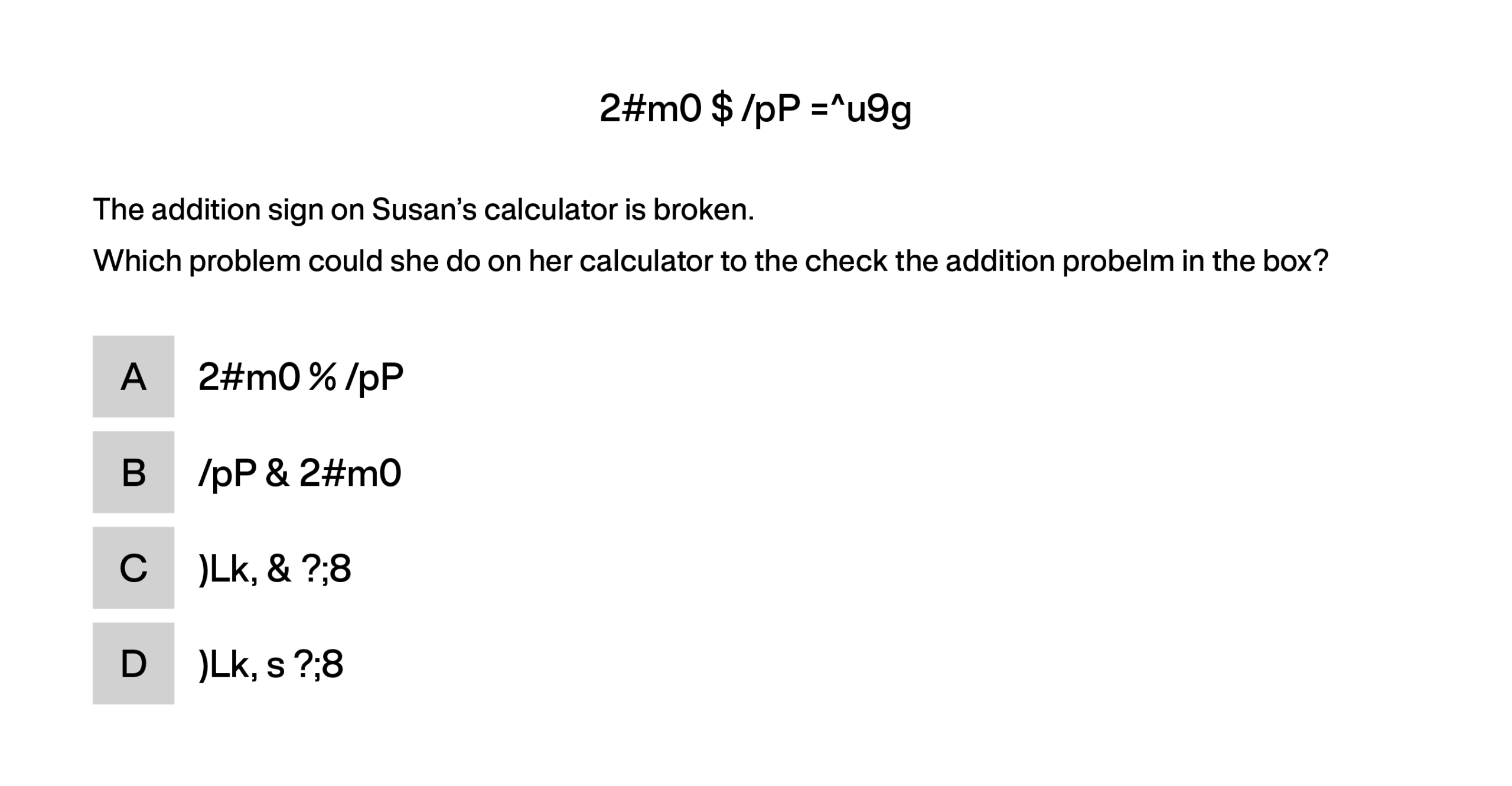
Source: https://www.nationsreportcard.gov/mathematics/sample-questions/?grade=4
Dyscalculia manifests differently from person to person, so our interpretation of how this question might look for someone with dyscalculia should not be perceived as how everyone with dyscalculia would see this question. It’s important to listen to the needs and experiences of the individual to understand what accommodations would help them.
How a person with dyscalculia might perceive this question
What the question intends to test
The question intends to test two areas; understanding that addition and subtraction are inverse operations and knowing you can check 1,364 + 798 = 2,162 by doing 2,162 − 798 = 1,364
What it may actually feel like is. The numbers themselves are intimidating. Four-digit numbers with commas can feel visually heavy and may feel more like symbols than quantities. The student may have trouble keeping track of which number is the total and which are the parts. They may start to feel tired by just looking at the problem.
The word problem adds cognitive friction. “The addition sign on Susan’s calculator is broken…” For someone with dyscalculia, this introduces a hypothetical constraint that must be held in working memory. They must mentally translate, “I can’t add” to “I must use a related operation.” This also combines language processing with math processing, at the same time confusing students and making them question what they are allowed to do.
Inverse operations are not intuitive. Even if they’ve been taught this many times “inverse” may feel abstract rather than logical; The relationship between 1,364 + 798 and 2,162 – 798 may not feel obvious. They might know subtraction is “related,” but not confidently know which number to subtract from which number.
Multiple-choice makes doubt louder. Looking at the options, options A and D could feel like a distraction, B and C feel tempting because they reuse the original numbers, but you can only tell that C is correct if you clearly track the roles.
Because number sense may be weak, elimination strategies feel unreliable, and guessing becomes common, even with partial understanding. Students may look at answers B and C, deem them the most likely, and just pick one.
Working memory overload. To solve this, the student must remember the original equation, identify the total, recall the inverse operation, and match it to the correct choice. For someone with dyscalculia, this can exceed working memory capacity. This can result in errors that look like “careless mistakes” but are actually cognitive overload.
The emotional fatigue. Repeated experiences like this may lead to low confidence, math anxiety, and second-guessing even correct reasoning.
“Educators need practical, classroom-ready strategies and tools to support students with dyscalculia—not abstract theory—so that all learners can access math instruction with confidence and clarity.” – Dr. Sandra Elliott, Author, “Sum Thing Is Up”
We should ask ourselves, does this question measure intelligence? Or does it measure comfort with symbolic number manipulation, memory under pressure, and fluency with abstract relationships?
Those are exactly the areas dyscalculia affects.
How can we make changes to this question to accommodate a student with dyscalculia?
Original question:
1,364 + 798 = 2,162
The addition sign on Susan’s calculator is broken.
Which problem could she do on her calculator to check the addition problem in the box?
Choices:
- A. 798 × 1,364
- B. 1,364 − 798
- C. 2,162 − 798
- D. 2,162 ÷ 798
Dyscalculia-friendly rewrite
By rewriting this question, we can achieve the same rigor with a lower cognitive load. Let’s look at it two ways; structured for assessments and structured for visual support.
Structured for assessments (explicit)
Susan added 1,364 and 798 and got 2,162. You can check an addition problem by using subtraction.
- Start with the total (2,162).
- Subtract one of the addends (798).
Which calculation checks the addition?
This keeps:
- inverse operations
- multi-digit numbers
- conceptual reasoning
Removes:
- linguistic confusion
- working-memory overload
Structured for visual support
To check an addition problem, subtract one addend from the total.
- Total: 2,162
- Addends: 1,364 and 798
Which calculation does that?
This version helps students organize the numbers before reasoning.
Accommodations that preserve rigor
These do not change the math goal, only the access.
Instructional accommodations can strengthen conceptual understanding for students with dyscalculia while improving clarity and access for all learners. Examples include allowing students to label numbers (circle the total, box the addends) or providing a one-line reminder, “To check addition, subtract one addend from the total.”
Assessment accommodations can maintain the integrity of the assessment while ensuring that results reflect mathematical understanding rather than barriers related to working memory, visual processing, or processing speed. Examples include letting students use scrap paper or highlighters, reading the problem aloud, and reducing visual clutter.
Language accommodations can help ensure that students are being assessed on mathematical understanding rather than on their ability to decode complex or ambiguous language. Examples include replacing story-based constraints (“broken calculator”) with direct instructions and using consistent vocabulary (total, addend, difference, etc.)
None of this provides the answer. It simply clears the fog so thinking can happen.
Explaining why a student chose the “wrong” answer
This is key for teachers, parents, and evaluators. Wrong answers are usually logical within the student’s internal model.
Mapping wrong choices to cognitive struggles
Choice A: 798 × 1,364
What the student may be thinking: “I need to combine the numbers somehow.”
Underlying struggle:
- Weak operation discrimination
- All operations feel interchangeable
- “Bigger operation = more checking”
What this tells you:
- Student does not have stable mental categories for operations
- This is not carelessness
Choice B: 1,364 − 798
What the student may be thinking: “The question said subtraction, and these are the original numbers.”
Underlying struggle:
- Difficulty identifying the total
- Over-reliance on surface features (reusing given numbers)
- Inverse concept understood partially, not fully
This is a very common dyscalculia error.
Choice C: 2,162 − 798 (Correct)
What the student understands:
- The total must be involved
- Subtraction undoes addition
- Roles of numbers are clear
This choice shows conceptual understanding, not just procedural skill.
Choice D: 2,162 ÷ 798
What the student may be thinking: “Division is the opposite of multiplication… and multiplication is kind of like addition?”
Underlying struggle:
- Blurred inverse-operation relationships
- Weak conceptual map of operations
- Symbol confusion (÷ feels as valid as −)
What this question really diagnoses
Choice | Reveals difficulty with |
A | Operation meaning |
B | Number roles (total vs part) |
C | Solid inverse understanding |
D | Operation hierarchy |
This is powerful diagnostic information—if we interpret it correctly.
A student with dyscalculia may understand the idea, want to reason correctly, and still choose the “wrong” answer because the barrier is access, not intelligence.
Explicit, systematic instruction like TouchMath can help students with dyscalculia understand foundational math.