
Counting money and cognitive load
Math, memory, and misinterpretation part 2
For many students, this question appears straightforward: add up the money shown. But for a student with dyscalculia, this task isn’t simple.
In this series, we’re examining how standardized math questions can unintentionally measure access barriers rather than mathematical understanding—and what we can do about it.
Important note: Dyscalculia presents differently in every learner. The interpretation below reflects one possible experience, not a universal one. The most effective supports come from listening to individual student needs.
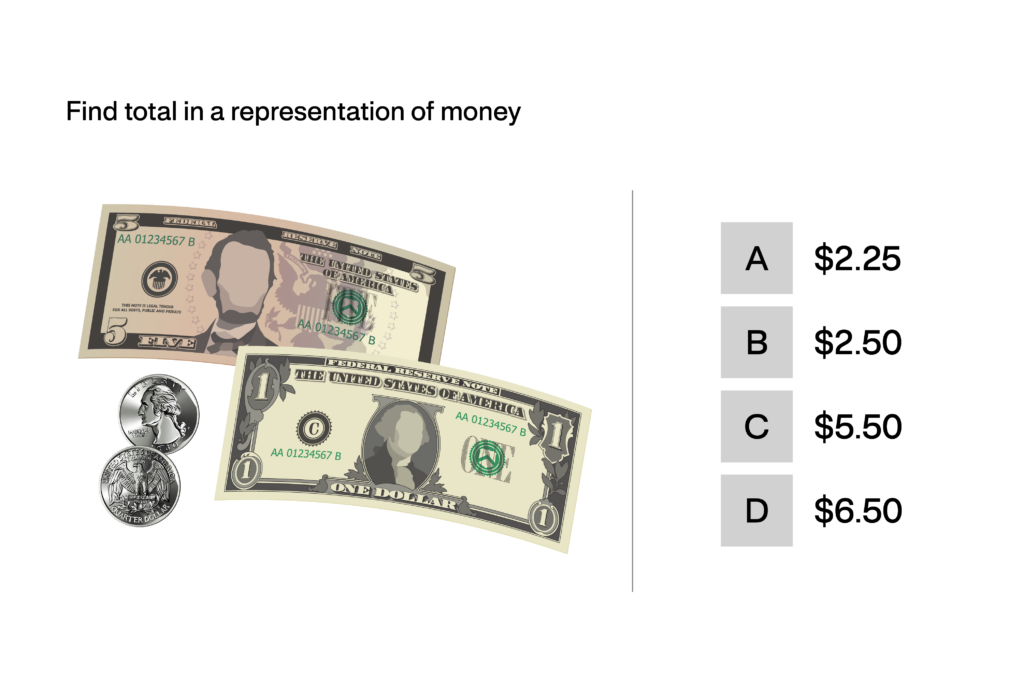
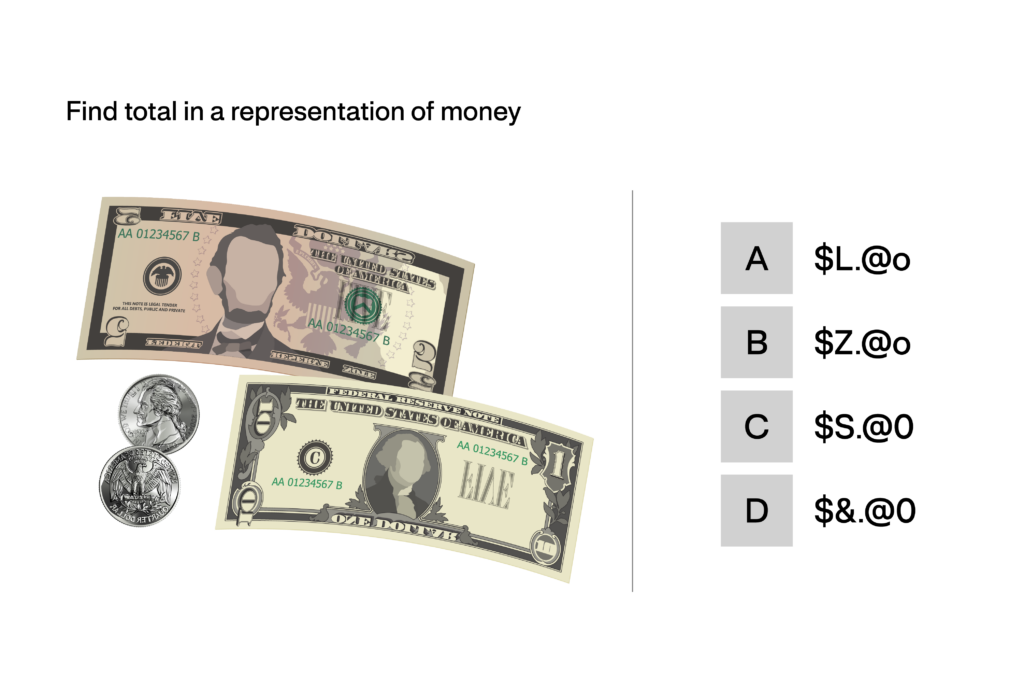
Source: https://www.nationsreportcard.gov/mathematics/sample-questions/?grade=4
Question: How much money is shown?
- $5 bill
- $1 bill
- Two quarters
Choices:
- A. $2.25
- B. $2.50
- C. $5.50
- D. $6.50
What the question intends to measure
This question is designed to assess:
- Understanding of money values (bills and coins)
- Ability to combine different units (dollars and cents)
- Basic addition with decimals
- Foundational number sense
On the surface, it’s a straightforward application of real-world math.
How This Question May Feel to a Student with Dyscalculia
Again, the gap between intention and experience matters.
Visual processing overload
The student must interpret:
- Two different bill values ($5 and $1)
- Two identical coins (25¢ each)
Instead of seeing a total, they see multiple symbols that must be decoded first.
Symbol-to-value translation
Each piece of money is not just a number—it must be translated:
- “25¢” → 0.25 → part of a dollar
- Bills → whole numbers
- Coins → fractional values
This constant translation increases cognitive load before addition even begins.
Difficulty combining units
Mixing dollars and cents requires:
- Understanding place value (ones vs. hundredths)
- Converting coins into decimal form
- Holding partial totals in working memory
For a student with dyscalculia, this is not automatic—it’s effortful and fragile.
Working memory strain
To solve correctly, the student must:
- Identify each value
- Convert coins to dollars (or count in cents)
- Add across units
- Track the running total
That’s multiple steps happening simultaneously—often exceeding working memory capacity.
Distractor answers feel equally plausible
Let’s look at the choices through a dyscalculic lens:
- A ($2.25): Might come from adding only part of the values or misinterpreting coins
- B ($2.50): Common if the student sees “two coins = 50” but misses the bills
- C ($5.50): Student includes the $5 and coins but misses the $1
- D ($6.50): Requires correctly integrating all components
Without strong number sense, each option can feel equally reasonable, making guessing more likely.
The question we should be asking
Is this question measuring:
- Understanding of money and addition?
Or:
- Visual decoding
- Unit conversion
- Working memory capacity
- Symbol translation
For students with dyscalculia, these are not side tasks—they are the task.
A dyscalculia-accessible rewrite of the question
Version 1: Structured for assessment (explicit)
Count the total amount of money.
- $5 bill
- $1 bill
- 25¢ + 25¢
First, add the coins.
Then add the bills and coins together.
What is the total?
Why this helps:
- Breaks the task into steps
- Reduces working memory load
- Makes the process explicit
Version 2: Structured for visual support
Bills: $5 + $1
Coins: 25¢ + 25¢
What is the total amount?
This separates categories so the student doesn’t have to mentally organize them.
Accommodations that preserve rigor
Instructional accommodations can…
- teach money using grouped categories (bills vs. coins)
- use visual anchors (e.g., 4 quarters = $1)
- explicitly model converting cents to dollars
- allow students to write intermediate totals
- reinforce counting strategies (counting up vs. converting)
Assessment accommodations can…
- allow scratch space for tracking totals
- permit manipulatives or visual aids (real or drawn coins)
- reduce visual clutter in the image
- present one step at a time (coins first, then total)
- allow extended time for multi-step processing
Language accommodations can…
- replace “How much money is shown?” with
“Add all the money to find the total amount.” - explicitly name categories (bills, coins, total)
- avoid requiring students to infer steps
- use consistent phrasing across instruction and assessment
Understanding “wrong” answers as meaningful data
Choice A: $2.25
Possible thinking: Partial counting or misreading values
Reveals: Difficulty combining multiple quantities
Choice B: $2.50
Possible thinking: Focus on coins only (25 + 25 = 50)
Reveals: Missed integration of all components
Choice C: $5.50
Possible thinking: $5 + 50¢, ignoring the $1
Reveals: Incomplete tracking of items
Choice D: $6.50 (Correct)
Shows:
- Accurate value recognition
- Successful unit integration
- Stable number sense
What this question actually diagnoses
Choice | Reveals difficulty with |
A | Value interpretation |
B | Integrating all parts |
C | Tracking multiple quantities |
D | Complete number sense |
Classroom takeaways for educators
- Representation is not neutral. Images add decoding demands that can mask understanding.
- Multi-step problems increase hidden load. Even “simple” problems may require several cognitive steps.
- Money is conceptually complex. It combines number sense, place value, and unit conversion.
- Students may understand parts—but not integration. Look for where the breakdown occurs.
- Clarity improves equity. When structure is visible, reasoning becomes possible.
Alignment with UDL and MTSS
UDL
- Representation: Separate bills and coins visually
- Action & Expression: Allow drawing or grouping
- Engagement: Reduce frustration through clarity
MTSS
- Tier 1: Clear structure, consistent language
- Tier 2: Guided grouping strategies
- Tier 3: Manipulatives, step-by-step scaffolds
This is not just a question about money. It’s a question about how students process information, how many steps we expect them to hold, and whether we are measuring math—or access to math.
When we reduce unnecessary barriers, we don’t make math easier. We make understanding visible.