
Rulers, Rounding, and Hidden Cognitive Load
Math, memory, and misinterpretation part 3
At first glance, this problem seems simple: use a ruler, measure a picture, and give the length. But for a student with dyscalculia, this task is not just about measurement—it’s about visual alignment, spatial reasoning, scale interpretation, and rounding, all at once.
In this series, we continue to examine how standardized math questions can measure access barriers instead of mathematical understanding—and how we can redesign them without lowering rigor.
Important note: Dyscalculia presents differently across learners. The experience below reflects one possible interpretation, not a universal one. Effective support always begins with the individual student.
The original question
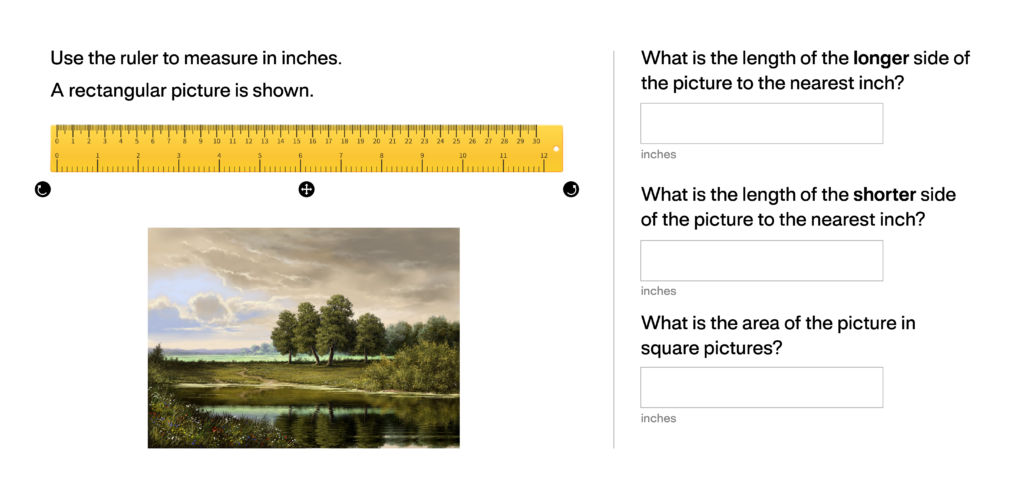
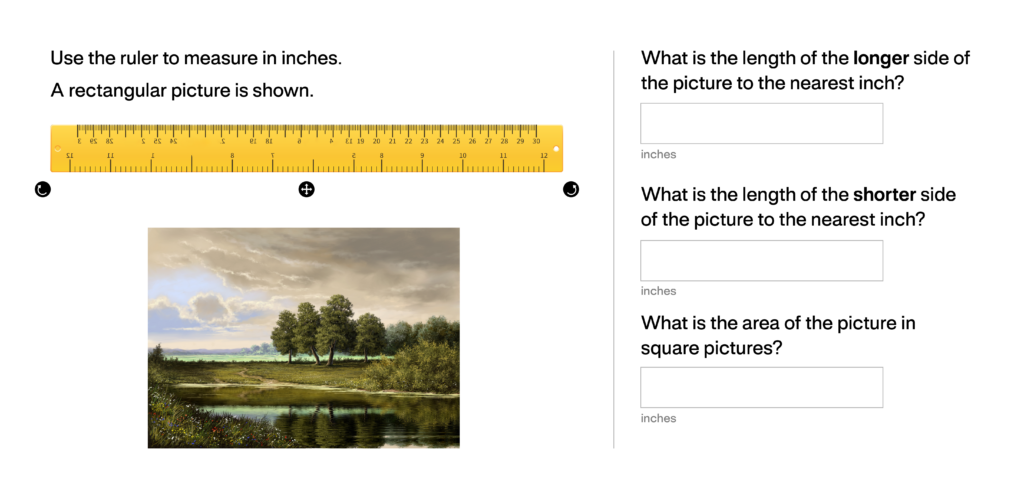
Source: https://www.nationsreportcard.gov/mathematics/sample-questions/?grade=4
Use the ruler to measure in inches. A rectangular picture is shown.
What is the length of the longer side of the picture, to the nearest inch?
What the question intends to measure
This question is designed to assess:
- Understanding how to use a ruler
- Ability to measure length in inches
- Knowledge of rounding to the nearest whole number
- Basic spatial reasoning
This is a foundational real-world math skill.
How this question may feel to a student with dyscalculia
Visual alignment challenges
The student must:
- Align the edge of the rectangle with the ruler
- Identify the starting point (not always zero)
- Track where the edge lands
For students with dyscalculia, spatial alignment is not automatic—it requires intense visual focus.
Scale interpretation
A ruler is not just a tool—it’s a number line with subdivisions:
- Whole inches
- Fractional marks between them
The student must interpret:
- What each tick mark represents
- Whether the measurement is closer to one number or another
This is essentially reading a compressed number line, which is often difficult for students with dyscalculia.
Rounding adds another layer
Even if the student measures correctly (e.g., 7.6 inches), they must:
- Decide whether to round up or down
- Recall rounding rules
- Apply them under pressure
Now the task is no longer just measurement—it’s measurement + number sense + decision-making.
Working memory overload
To answer correctly, the student must:
- Align the ruler
- Read the measurement
- Interpret the scale
- Apply rounding
That’s multiple cognitive steps, all dependent on accuracy at each stage.
Errors can occur anywhere in the chain.
The “nearest inch” trap
The phrase “to the nearest inch” adds linguistic ambiguity:
- Some students may ignore it
- Others may misapply rounding
- Others may second-guess a correct measurement
This is not just math—it’s language + interpretation + math.
The question we should be asking
Is this question measuring:
- The ability to measure and round?
Or:
- Visual-spatial precision
- Interpretation of a number line
- Working memory under pressure
- Language processing
For students with dyscalculia, these are not separate—they are intertwined.
A dyscalculia-accessible rewrite of the question
Version 1: Structured for assessment (explicit)
Measure the longer side of the rectangle using the ruler.
- Start at 0 on the ruler
• Find where the side ends
• If the measurement is between two numbers, round to the nearest inch
What is the length?
Why this helps:
- Makes the process visible
- Reduces ambiguity
- Supports step-by-step reasoning
Version 2: Structured for visual support
The longer side measures between ___ inches and ___ inches.
It is closer to ___.
What is the length to the nearest inch?
This version scaffolds the rounding decision explicitly, rather than expecting it to happen internally.
Accommodations that preserve rigor
Instructional accommodations can…
- explicitly teach how to align a ruler at zero
- use number line models alongside rulers
- practice reading tick marks as intervals, not just lines
- connect measurement to benchmark lengths (e.g., 6 inches ≈ pencil)
- model rounding using visual number lines
Assessment accommodations can…
- allow physical rulers instead of printed approximations
- provide clear starting points (marked zero)
- reduce visual clutter around the measurement image
- allow verbal explanation of reasoning
- provide extended time for multi-step processing
Language accommodations can…
- clarify “nearest inch” with
“round to the closest whole inch” - break directions into steps instead of a single sentence
- use consistent phrasing aligned with instruction
- avoid embedding multiple expectations in one sentence
Understanding “wrong” answers as meaningful data
While answer choices aren’t shown here, common error patterns include:
Measuring from the wrong starting point
Reveals: Difficulty with spatial alignment and tool use
Choosing the lower whole number without rounding
Reveals: Partial understanding of measurement, weak rounding
Rounding incorrectly
Reveals: Weak number line understanding
Large misestimation
Reveals: Difficulty interpreting scale altogether
What this question actually diagnoses
Error type | Reveals difficulty with |
Misalignment | Spatial reasoning |
Misreading ticks | Scale interpretation |
Incorrect rounding | Number sense |
Skipped rounding | Instruction comprehension |
Classroom takeaways for educators
- Measurement is not a single skill.
It combines spatial reasoning, number lines, and rounding.
- Tools introduce complexity.
A ruler is a cognitive tool, not just a physical one.
- Language matters.
“Nearest inch” is a small phrase with a big impact.
- Errors show where the breakdown occurs.
Look for the step—not just the final answer.
- Structure reveals understanding.
When steps are visible, reasoning becomes clearer.
Alignment with UDL and MTSS
UDL
- Representation: Clear ruler markings, visual supports
- Action & Expression: Allow demonstration with tools
- Engagement: Reduce frustration through clarity and structure
MTSS
- Tier 1: Explicit instruction on ruler use and rounding
- Tier 2: Guided measurement with visual scaffolds
- Tier 3: Hands-on tools, step-by-step supports, repeated modeling
This is not just a measurement problem. It’s a coordination problem—between:
- what students see
- what they interpret
- and what they’re expected to do with it
When we reduce unnecessary barriers, we don’t make the math easier. We make the thinking visible.